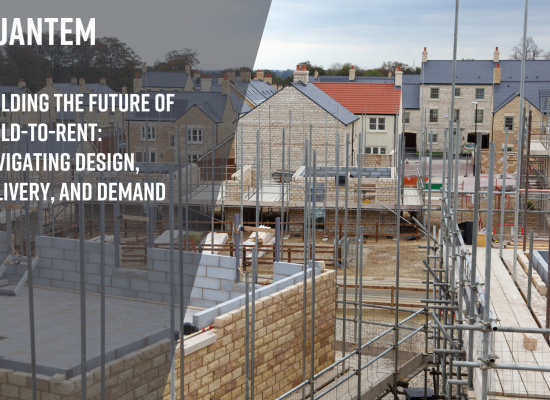

Building the Future of Build-to-Rent: Navigating Design, Delivery, and Demand
The UK’s Build-to-Rent (BtR) sector continues to evolve rapidly, presenting unique challenges and opportunities as developers, designers, and investors adapt to changing market dynamics, regulations, and customer vs operator expectations.
Procurement, Building Safety and Gateways
One of the central themes is the shift in procurement and design strategies. Traditionally, many BtR projects had relied on a single-stage Design and Build (D&B) approach. However, the current environment, with increased regulatory scrutiny, particularly around building safety and Gateway approvals is pushing the sector to two-stage procurement with consideration for much more design to generate a Gateway 2 application.
The Gateway process has introduced an intensity the sector is still adjusting to. Several teams describe it as “planning problems squared,” reflecting the volume of design information required, RFIs, the speed of turnaround expected, and the strain placed on designers who are often working weekends to meet five-day response windows. This pressure reinforces the need for early clarity, coordinated strategies, and realistic programming from day one.

This has led to a preference for more integrated design arrangements, such as Pre-Construction Services Agreements (PCSA), which bring specialist designing subcontractors into the fold earlier. This integration is critical, especially for complex systems like sprinklers, which demand specialist input to ensure designs are robust and compliant before Gateway application and long before any construction begins.
There is a growing recognition that detailed design and cost certainty needs to be developed earlier in the process to secure funding, meet safety requirements, build in value to these projects, and capture VE to avoid post Gateway submission change – this not just cost related, but as regulatory requirements evolve, even seemingly minor technical changes can have significant ripple effects. A single change to a door specification can multiply across hundreds of units, reshaping budgets in ways that weren’t earlier anticipated.
Early involvement allows us to quantify these impacts with precision and give clients the clarity they need to move forward confidently. Though design lies primarily with Architects and Engineers, the role of Quantem in scrutinising and benchmarking incoming designs is essential – by comparing cost metrics but also cost metrics such as net-to-gross ratios, average dwelling & room sizes, and floor efficiencies against comparable schemes; we help ensure projects deliver value without compromising on quality or cost efficiency. This early certainty benefits investors, developers, and future residents alike, by reducing risk and fostering quality delivery.
These benchmarks also aid in understanding the risk profile of each scheme and how it aligns with broader market expectations. Our work supports in detailed documentation contributing to the “golden thread” of safety information, ensuring accountability and transparency for the BSR’s review. Quantem involvement in projects enables smoother submissions and avoids costly, time-consuming revisions.

Later Living
As the Build-to-Rent sector matures, tenant expectations and demographic shifts are increasingly influencing building design and operational strategies. The rise of later living and multi-generational housing is one such trend.
More and more older people want flexible, amenity-rich rental options that offer a balance of private and communal space, without feeling like you’re back in student accommodation. Two key priorities are being part of a community and enjoying an enhanced quality of life.
This demographic shift presents both opportunities and challenges. Affordability is paramount especially for those on fixed incomes, pensions or in social housing, so it is critical to control construction costs and maintain manageable levels of rent.
Quantem understands the diversity of alternative senior living and how to deliver this well. Through our work with Preferred Homes Limited, an affordable provider of later living accommodation, we are helping to build later living facilities in demographic areas that need them most.
We take redundant and often difficult sites that are no longer fit-for-purpose and create cost delivery plans that overcome site inefficiencies, funding and planning challenges all of which impact the overall cost per sq ft and rentable spaces.
“We greatly value the work Quantem does for Preferred Homes. They are a trusted partner and their sound advice and hands-on delivery has made them integral to our ongoing success.” – Preferred Homes Limited

Futureproofing / Co-Living / Single Family Homes
Meanwhile, emerging models like co-living cater to younger professionals and post-graduate residents, emphasising shared communal facilities and high-density accommodation. These developments often benefit from modular construction and economies of scale but also require careful consideration of amenity quality and tenant experience to ensure long-term viability and avoid the voids we see as tenants move on and out of city centre locations. Conversely, single-family housing in the rental market offers lower-density suburban contexts that avoid Gateway programme risk, and the cost pressures of vertical construction with extensive amenity provision, but brings different challenges around location, transport, and community infrastructure. As affordability faces renewed pressure, the co-living and single-family housing are poised for growth.
Co-living continues to draw interest, but developers must guard against drifting too close to student-accommodation typologies. Residents expect quality, privacy, and meaningful communal spaces, not a rebadged student block. Well-designed amenity provision varied unit types and thoughtful density strategies are essential to long-term retention. This in turn presents operational challenges that continue to shape how rental projects are delivered. For example, parking remains a contentious issue, with some developers rethinking traditional car park spaces in favour of alternative uses, such as bike storage or even lifestyle amenities. These adaptations and operational innovations reflect a broader trend toward creating differentiated offers that appeal to tenants and add value in competitive markets.
Futureproofing the rental sector requires a proactive approach to demographic shifts, tenant lifestyle changes, and regulatory developments. Projects might benefit from flexible designs that accommodate multi-generational living, integrate internal and external communal spaces, and allow for adaptation over time. The residential sector is also responding to environmental and technological challenges by embracing energy efficiency and digital innovation, ensuring that rental living remains relevant and sustainable in the long term.

What does rental reform mean for the UK Build to Rent sector?
The recent rental reforms, including the abolition of no-fault evictions and the move to periodic tenancies, are driving a greater focus on tenant retention. This legislative shift means BtR operators must design buildings and communities that encourage longer tenancies, reduce turnover costs, and build a sense of place. Technology, service innovation, and community-building are becoming essential components of successful BtR offerings in this new regulatory landscape, and with this comes a rising need for more convergence between the operators and what their schemes offer.
Driving best value for home rental affordability
“Values are more sensitive than cost” – One repeated insight is that in viability, BtR is more sensitive to value than to cost. While build costs typically rise once with legislative change, rental value increases compound year after year. A marginal improvement in value can therefore outweigh a seemingly significant increase in cost, provided the project is designed to attract and keep the right residents.
From a financial perspective, viability remains a balancing act between cost and value. Higher densities, such as those seen in co-living, come with increased costs per home, more kitchen space and bathrooms, for example but also generate higher rental income density. The critical factor is ensuring that increases in rental value outpace cost inflation, as viability is often more sensitive to value changes than cost increases. Developers and investors must remain vigilant in setting realistic budgets and continually validating design decisions against evolving market conditions.
We’ve seen UK rents run beyond inflation and wage growth, driven by rising landlord costs, limited housing supply, and strong demand, though long-term growth is more aligned. Quantem have reflected on values and cost changes over recent years and published their findings here (https://www.quantem.co.uk/wp-content/uploads/2024/07/240717-Change-in-Forecast-Cost-Value-in-Resi-Sector.pdf). Quantem set design and cost metrics at the outset of a project, harness team skills and experience to deliver to these metrics and validate the evolving design as it progresses.
In summary, UK Build-to-Rent, co-living and single-family housing are at a pivotal moment. Success hinges on early and integrated design collaboration, thoughtful benchmarking of quality and cost, responsiveness to evolving tenant needs, and a forward-looking approach to regulation and market trends. By embracing integrated collaboration and innovative thinking, the rental living sector can meet both todays and tomorrow’s renter needs, delivering homes that truly serve communities and investors alike.
More News & Insights...
- All Post
- Back
- News
- Insight
- Publications